
'Today, Shah Rukh is sitting so high up that it will have to be something really spectacular for him to jump up and say, "Hey, yes, let's make this film!".'
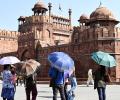
In Rajasthan, Pilani recorded 44.9 degrees Celsius, Phalodi and Churu touched 43.8 degrees Celsius and 43.5 degrees Celsius respectively, while Bikaner and Jaipur registered 43.4 degrees Celsius and 43 degrees Celsius.

The weather office said intensity of heat wave/severe heat wave has slightly reduced over some parts of northwest and adjoining central India.

June rainfall accounts for 15 percent of the total precipitation of 87 cm recorded during the four-month monsoon season in the country.

Archaeological explorations in Topra Kalan village, Yamunanagar district, Haryana, have revealed ancient remains and cultural artifacts, suggesting human habitation dating back approximately 3,500 years. The findings include Painted Grey Ware (PGW) and other ancient materials, with further investigations planned to determine the exact age and significance of the site.

States are mandated to develop and implement 'heat HAPs' for prevention of heat-induced diseases. But most do not go beyond standard advisory on heat prevention.

India has received 20 per cent less rainfall since the start of the monsoon period on June 1, with the rain-bearing system making no significant progress between June 12 and 18, according to the India Meteorological Department (IMD).

Prime Minister Narendra Modi and his British counterpart Keir Starmer discussed the need to prevent the misuse of democratic freedoms by extremist ideologies. They also addressed terrorism and trade ties.

Wheat production during the current season is expected to be better than last year provided the weather remains favourable over the next few weeks, said senior industry executives. The weather had turned uncharacteristically hot in the latter half of last month, but owing to strong winds, the chill has returned in the last few days.

Above-normal heatwave days are predicted in most parts of central, east and northwest India during this period.

'In India no matter your lifestyle, you will end up doing the same things as everybody else.'

With the summer approaching sooner than scheduled, Maharashtra, Telangana, Odisha, and West Bengal have already started experiencing heat waves with temperatures soaring above 40°C.

A controversy has erupted after an NCERT Class 8 textbook depicted present-day Rajasthan as part of the Maratha Empire, drawing criticism from royal families and political leaders who call the depiction factually incorrect and misleading.

'People ask me about my biggest action sequence; this is it, because it involved two giants of Indian cinema.'

Temperatures in 17 locations breached 48 degrees Celsius on Monday, with the relentless heat affecting health and livelihoods across large parts of northwestern and central India.

After churning across the Arabian Sea for more than 10 days, Biparjoy made landfall near Jakhau Port in Gujarat on Thursday.

Brace for some warmth this winter as the India Meteorological Department (IMD) in its December-February forecast on Thursday said that the minimum and maximum temperatures could remain 'normal' to 'above normal' over most parts of Northwest and Northeast India. Both the minimum and maximum will remain below normal in Southern Peninsular and Central India in these winter months. While this could give some respite from the intense cold of North India, it could have a negative impact on the standing rabi crops if the temperature rise is unusual and abnormal.

Data since 2005 show that the five years with the highest rainfall saw average market returns of 8.98 per cent, while the five driest years returned 25.7 per cent on average.

Of the 22 crew members on board the ship, MV Wan Hai 503, 18 have abandoned the vessel and are being rescued by Indian Navy and Coast Guard assets, he said.

The India Meteorological Department (IMD) predicted that cold wave to severe cold wave conditions are very likely to continue in northwest India over the next three days and abate thereafter.

Body of Bhabesh Chandra Roy, 58, a resident of Basudebpur village of Dinajpur, about 330 kilometres northwest of Dhaka, was recovered on Thursday night, The Daily Star said quoting police and family members.

A thunderstorm accompanied by heavy rain battered Delhi overnight, disrupting flight operations, uprooting trees and electricity poles, and causing waterlogging in several areas while bringing relief from stifling heat. The sudden change in weather led to a sharp drop in mercury with the city recording a minimum temperature of 19.8 degrees Celsius, 6.9 notches below the normal. The India Meteorological Department said the city's primary weather station at Safdarjung recorded winds gusting up to 82 kmph and 81.2 mm of rain in six hours -- between 11.30 pm and 5.30 am.

The Met office had said Monday that significantly higher-than-normal temperatures may have an adverse impact on wheat and other crops.

Hailstorms were reported at various parts of the national capital including Palam, Chilpighat and Ayanagar, the IMD said.

The southwest monsoon is set to make its exit in style, bringing rains to the parched parts of Uttar Pradesh and Bihar, as weather forecasters have picked up signs of formation of a cyclonic circulation over Bay of Bengal. Addressing a press conference in New Delhi, India Meteorological Department (IMD) director general Mrutyunjay Mohapatra on Thursday junked last week's forecast of early withdrawal of southwest monsoon and announced the extended stay of the seasonal showers. "Even though we expected early withdrawal of the southwest monsoon, a cyclonic circulation over west-central and adjoining northwest Bay of Bengal will shift the monsoon trough southwards around September 7.

'Dense' to 'very dense' fog prevailed in parts of Punjab, Haryana, west Rajasthan, Bihar, Delhi, west Uttar Pradesh, Jharkhand, Odisha and Assam.
'The intensity and frequency of heatwaves will be much higher than in previous years over Punjab, Haryana, Rajasthan, Gujarat, Madhya Pradesh and Odisha.'

As fire continued to rage on and explosions rocked the Singapore-flagged ship off the Kerala coast on Tuesday, authorities issued an oil spill advisory while a Chinese engineer rescued from the burning vessel suffered critical injuries.

'He had just come out of the ICU after surgery.' 'He opened his eyes, spoke to Sara for a bit, and asked for me.' 'I said, "I'm right here, dad." 'And then he said, "If you were there, you would've beaten that guy up".'

The weather department said its latest model analysis had indicated that the moist easterly winds in the lower level from the Bay of Bengal would spread to northwest India, covering Punjab and Haryana by July 10, leading to the advancement of monsoon and an increase in rainfall activity over the region, including Delhi, from July 10 onwards.

Rainfall in August is predicted to be below normal (less than 94 per cent of LPA), but the situation is expected to improve comparatively in September, the IMD said.

'We are too important to want to be paired with Pakistan but too intensely connected to it to successfully detach ourselves,' asserts Aakar Patel.

Satellite imagery showed a dense elongated band of fog stretching from Punjab to the northeast.

Cold-day conditions prevailed in parts of north India on Friday though the maximum temperatures rose slightly amid clear skies and sunshine during the day.

A 22-year-old youth and a person with disability died, while at least 11 were injured, in separate rain-related incidents in the national capital on Wednesday evening. The incidents occurred amid sudden changes in weather in Delhi, as a rainy storm marked by hail wrecked havoc across the city, throwing traffic out of gear as far as Delhi-Noida, Delhi-Ghaziabad, and Delhi-Gurugram roads and uprooting several trees.

Such weather conditions are not typical for May which tends to be the hottest month of the year in Delhi with a mean maximum temperature of 39.5 degrees Celsius.

The IMD said that rainfall over India in August and September would be around 106 percent of the long-period average of 422.8 mm.

At least 28 people died in rain-related incidents Sunday as heavy downpours lashed north and northwest India, causing landslides, traffic chaos and house collapses, as well as a dam breach which inundated several villages in Haryana.

India is likely to witness normal rainfall during the southwest monsoon season this year, the India Meteorological Department said on Thursday. Rainfall will be 96 per cent to 104 per cent of the Long Period Average (LPA) of 87 cm of the 1971-2020 period, it noted. Earlier, the IMD used to consider the LPA of 88cm of the 1961-2010 period.

'When I meet someone and feel something, and start dreaming about a big wedding, I will...'
